

On November 6 the first and only female Speaker of the House Nancy Pelosi (D-California) announced that after nearly four decades serving in the House of Representatives she would not be seeking reelection in 2026. At the end of her 20th and final term, she will be 86 years old, marking the end of a career that began when she was 37.

Source: Politico

Source: Axios
Pelosi’s retirement has addressed the long-standing issue age in politics. At 85, she isn’t even one of the oldest politicians, with that title falling on 92-year old Chuck Grassley (R-Iowa). The Pew Research Center places the median age of the Senate at 64.7 years old, with the median age of the House of Representatives being 57.5 years old. For reference, the median age in the United States is around 40 years old.
The main concerns that come as politicians age is their lack of connection with younger constituents. Younger people typically find it harder to relate to older politicians, who they believe have no understanding of the complexities of life as a younger person in the 21st century. Younger people also tend to hold more cynical outlooks towards the political system.

Source: CQ Roll Call & The United States Congress

Source: The Des Moines Register

Source: The New York Times
The constantly changing world means that the United States that many elected officials grew up in vastly differs from the country we are in today. For instance when Senators such as Grassley or even Bernie Sanders (I-Vermont) were seniors in high school in 1951 and 1959, Dwight Eisenhower (R) was the President, gas was 30 cents per gallon, Alaska and Hawaii had just become states, and Walmart had not even been founded.
As politicians increase their time spent in office, they increase their ability to be consistently reelected. The lack of term limits means politicians can spend decades in office, with health concerns serving as sometimes the only indicator of retirement.
The increased risk of health concerns that come with age, coupled with the workload and mental toll of public service has voiced many concerns over the implications of politicians’ health as they age. Many politicians who have passed due to complications from old shortly after leaving, or while still in office have been seen as examples of the risks of older politicians. In 2023, Senator Dianne Feinstein (D-California) took a three month absence from Congress due to health issues.

Source: NBC

Source: NBC
Feinstein died at age 90 less than 6 months after giving this statement.
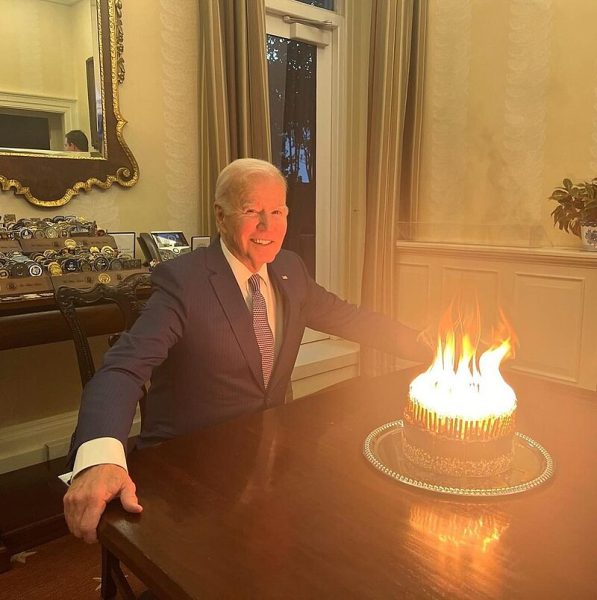
Senators, Representatives, and even Presidents of the United States haven’t escaped scrutiny due to health concerns and age. In 2016, Donald Trump (R) became the oldest president to assume the presidency since Ronald Reagan (R). In 2020, Joe Biden (D) would go on to break this record, assuming the presidency at 78 years old. In 2024, at the start of his second term Trump was 78 years old, before turning 79 in June of this year.
Source: Joe Biden’s Official Instagram
During his tenure in office, Joe Biden faced scrutiny as the oldest president in history. While president, Biden was treated for a foot fracture suffered while chasing his dog, a 2022 COVID diagnosis, a small cancerous legion, hyperlipidemia, gastroesophageal reflux, as well as spinal arthritis.
His performance during the first 2024 presidential debate raised skepticism over his ability to physically and mentally perform the duties of president for a second term. In July of 2024 President Biden dropped out of the presidential race. In May of 2025, Biden announced treatment for a prostate cancer diagnosis.
During his 2nd term in office, health concerns have ramped up surrounding Trump. The President’s diagnosis with chronic venous insufficiency has been cited as an explanation for the bruises around his hands, as well as the swelling that appears around his ankles. CVI occurs when the veins in the body fail to work, and often leads to blood collecting in the arms and legs and leads to swelling.

Source: NBC

Source: Getty Images
In addition to CVI, Trump’s mental state has been called into question. The White House has continued to release the president’s health records and emphasize that he is “fully fit to execute the duties of the Commander-in-Chief of the United States.”
As Trump has aged, critics have stated his ramblings have increased and cited this as examples of a declining mental state amplified by age. As with Biden, Trump’s attentiveness has been called into question, with his recent bouts of apparent drowsiness being seen by critics as examples of a declining mental acuity. Supporters have defended signs of apparent drowsiness as signs of the President’s work ethic as tiring him out, while critics have panned the President for what is seen as an incompetency in the nation’s highest position.
In a time where younger people feel increasingly disconnected from the government, it remains to be seen the trend in long-standing establishment politicians will continue, or if younger newcomers will make their steps on Capitol Hill.