

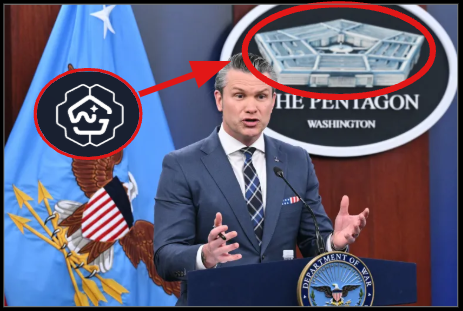
Peter Brian Hegseth. United States Secretary of Defense, or, as he would say, Secretary of War. Fox & Friends Weekend Cohost. Self-described defender of Western Civilization against diversity. Currently one of the most influential and controversial figures in our country. And, most significantly, probable Large Language Model aficionado.
In my research for the last issue’s article, reading through some of Hegseth’s statements on the war in Iran, I was struck by the notion that some of his comments seemed awfully AI-generated. In fact, it appeared to me that he or whoever had written his address had simply asked an AI to generate a statement about the strength of the US military, then inserted more comments about how “lethal” it was.
So, how can I go about evaluating my suspicions? I cannot definitively prove that Pete Hegseth or his speechwriters use AI without explicit confirmation from one of them, and I doubt that any of them will confess to using a Large Language Model to write their public statements.
Therefore, I need a disclaimer: this article does not claim to prove that some of Pete Hegseth’s public statements are written by AI. Rather, it is an explanation of why I think my suspicions are reasonable.
The Basis of my Suspicions
Look at the passage below. Notice anything about it?
“Peace through strength, the warrior ethos, lethality, unity of purpose, those are not slogans. They’re the beating heart of what it means to wear the uniform, that uniform. You think clearly under fire, you act decisively in chaos, you uphold the constitution and you uphold our country without hesitation. We are not defenders anymore. We are warriors, trained to kill the enemy and break their will. History is watching. Be the force you swore an oath to be focused, disciplined, lethal, and unbreakable [sic].”
This passage contains several hallmarks of LLM-generated writing and appears to be lightly human-edited. “Peace through strength, the warrior ethos, lethality, unity of purpose” and “focused, disciplined, lethal, and unbreakable” are both typical three-adjective AI phrases with “lethal” haphazardly jammed in, likely by Pete “Violent Effect, not Politically Correct” Hegseth himself. “Those are not slogans. They’re the beating heart of what it means to wear the uniform” contains multiple stock descriptors (“beating heart, what it means to [x]”) inside a greater “it’s not [x], it’s [y]” structure characteristic of LLMs.
The final nail in the coffin is the missing punctuation in the last sentence: “Be the force you swore an oath to be focused, disciplined, lethal, and unbreakable.” Between the second “be” and “focused,” there needs to be some sort of punctuation separating the two phrases. The most likely contender for what would have gone here is an em dash (—), which has a reputation as AI’s favorite punctuation mark. This and other paragraphs in Pete Hegseth’s addresses on the war in Iran seem to me to be at least partially written by an AI model, then edited by human reviewers.
Out of the 5 transcripts of public statements by Pete Hegseth posted on the Department of Defense website between January 9 and March 4, 2026, 2 were determined by the AI detection website GPTZero to be partially or totally written by AI (one each). This is not enough data to construct an accurate image of AI’s presence in Hegseth’s public statements, nor is it randomly selected, but it is a decent starting point.
I would also like to note that, in an evaluation of GPTZero’s accuracy published in the Journal of Korean Medical Science, GPTZero was far more prone to false negatives (wrongly classifying AI writing as human) than false positives (wrongly classifying human writing as AI). Of course, the study was conducted on AI- and human- generated medical texts, so that principle may not hold for this situation, but I nonetheless feel that between this and my own evaluations of the texts in question, my suspicions are justified.
Hegseth’s AI Accelerationism
Another factor that makes me believe that AI is somehow involved in Hegseth’s statements is that Hegseth is an eager proponent of AI use in the Department of Defense. He spearheaded the launch of an internal Pentagon AI model, GenAI.mil, and promised to make the US military an “‘AI-first’ warfighting force” with what the DoD referred to in a press release as an “Artificial Intelligence Acceleration Strategy.”
The Acceleration Strategy includes several plans for implementing artificial intelligence in different military functions. Among these include “Swarm Forge,” which the official press release describes as a
“Competitive mechanism to iteratively discover, test, and scale novel ways of fighting with and against AI-enabled capabilities – combining America’s elite Warfighting units with elite technology innovators”
in typical AI-like cadence. I would not expect an actual human being to consider “swarm forge” a good name either.
The internal AI model GenAI.mil is another part of this Acceleration Strategy. As shown in a screenshot of a conversation with the model from a Pentagon news release, it describes one of its functions as the ability to “create and refine… memos, emails, and briefings.” The news release credits Hegseth with assuaging department members’ skepticism over using the AI model. He reportedly told personnel, “log in, learn it and incorporate it into your workflows immediately. AI should be in your battle rhythm every single day; it should be your teammate.”
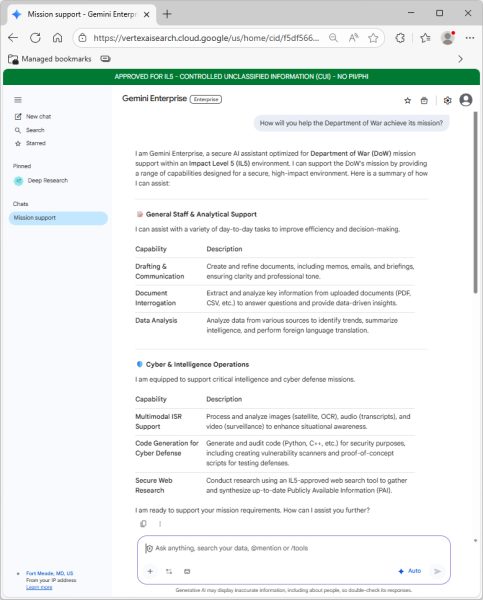
(My apologies; this is the maximum resolution I could find this photo in on the DoD website.)
Needless to say, this indicates that Pete Hegseth has access to, and is a large proponent of, a text-based AI model which could be used to draft briefings and press releases. This convinces me that he is at least willing to write his public addresses with AI, even if he does not, but also indicates a more problematic trend within the Department of Defense. The Department of Defense’s operations are progressively incorporating more and more AI, which could lead to the degradation of safeguards against the improper use of surveillance technology and lethal force as military power is handed over to automated systems. It has also led to questionable engagement with corporate America by the DoD; the Department has military AI contracts with Google and OpenAI, and designated AI company Anthropic as a supply chain risk after its CEO refused to give the DoD unrestricted access to its AI model Claude, citing concerns about its use in autonomous weapons and surveillance systems.
“We will not employ AI models that won’t allow you to fight wars… Department of War AI will not be woke.”
— Pete Hegseth
A Larger Problem
If Pete Hegseth is using AI to write speeches, he wouldn’t be the only one. Many members of Congress are openly using AI. Reps. Rho Khanna and Thomas Massie both told Business Insider that they use AI to research and edit their speeches. Sen. Ron Johnson claimed he once woke up at 3:00 in the morning and started writing arguments supporting federal budget cuts using GroK. Not every member of Congress is on board with this trend, but the prevailing sentiment is that, despite its shortcomings, such as its ability to hallucinate information that doesn’t really exist (known to humans as “being wrong”), AI is too convenient and readily accessible for politicians not to incorporate into their speechwriting process.
AI use is also being incorporated into other federal departments, like the DHS, the Department of Agriculture, and the Department of Health and Human Services. None of these appear to be implementing it to the extent that the DoD is, but we should soon expect many federal press releases, public speeches, and social media posts by politicians to be written by Grok, Gemini, ChatGPT, and various other LLMs.
I personally find it disheartening. In an era of increasing inauthenticity, many in the highest echelons of our government are choosing to embrace that inauthenticity by handing off their public expression to a computer program. And, in all likelihood, one of those people is Peter Brian Hegseth.