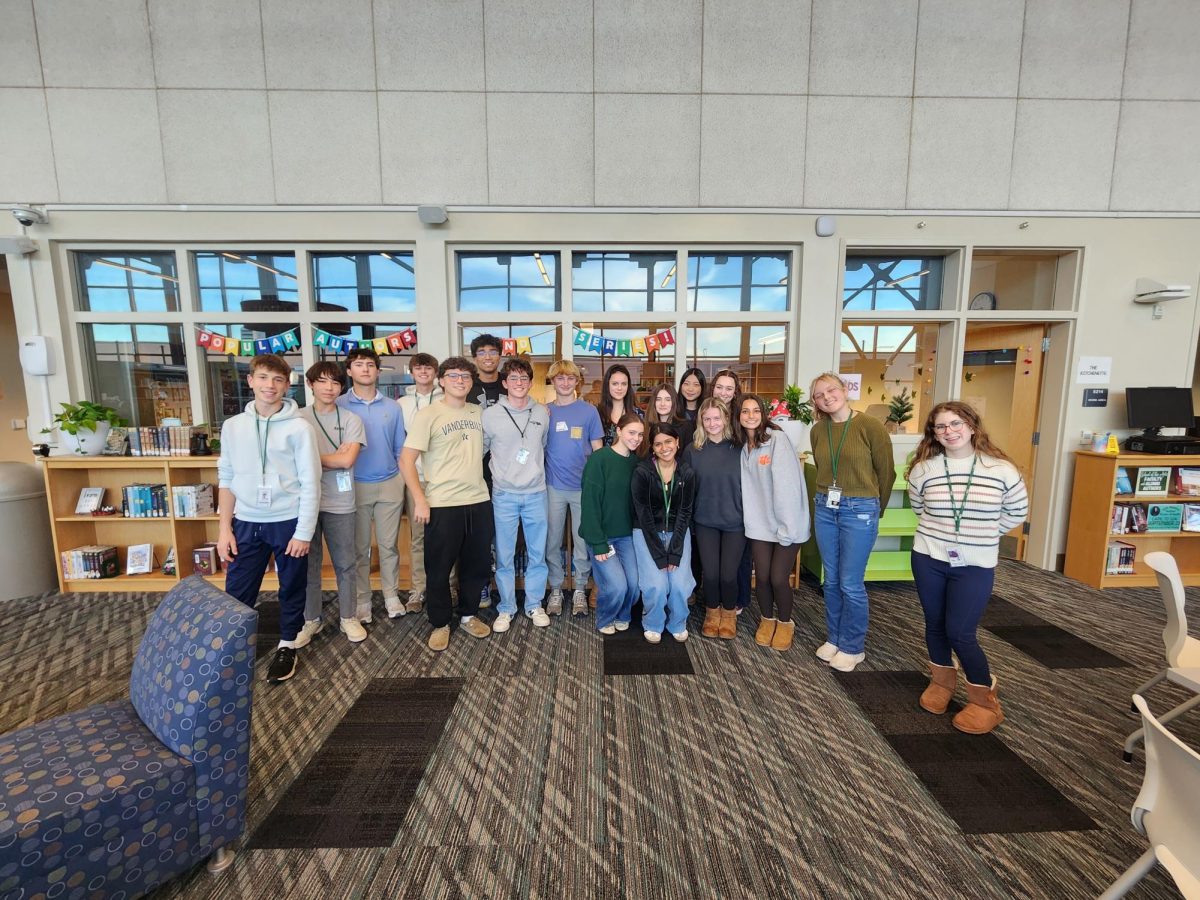

Behind the laptops, goggles, surveys, and spreadsheets, Academic Magnet seniors are working on research projects that ask bigger questions than what meets the eye. AP Research is the final course in the AP Capstone curriculum and requires students to identify an authentic research gap and develop an original research project to address it. For Magnet High students, this has meant research on classroom lighting and literacy rates, food dyes, social media coercion, and probability literacy, among other topics.
Though each research project has been unique, they all have one thing in common: the students’ desire to ask bigger questions about systems they encounter every day and to do so in a way that meets academic rigor.
Addressing Literacy in the Digital Age
Senior Kyler Richardson is tackling one of the biggest issues facing America: the declining rates of literacy among American students. His research aims to determine whether or not Bionic Reading, a technique that bolds the first half of words to direct eye movement, improves reading speed, confidence, and motivation among ninth graders.
The question that guides Richardson’s research is whether or not Bionic Reading can combat the decline in American students’ literacy by “increasing reading speeds as well as literary confidence and interest, as measured by the Adaptive Reading Motivation Measures-Revised (ARMM-R).”
“The idea is to see if participants actually experience these benefits,” Richardson said, especially in the context of “the literacy decline we’ve seen since COVID-19 and the emergence of short-form media.”
Bionic Reading has been making waves online, but Richardson found that there was one glaring hole in the research. “There hasn’t been a study with Bionic Reading that’s taken place in an American classroom unrelated to students with learning disabilities,” Richardson explained. His research, under the guidance of Mrs. Smith seeks to fill that void.
Investigating What We Consume
Naomi Moses is working on a research project in the lab to investigate the impact of one of the most common substances found in food: synthetic dye Blue 1. Her research question is: “What are the genotoxic and cytotoxic effects of the synthetic food dye Blue 1 on active root tip cells of Zea mays L. (corn)?”
Naomi Moses’ experimental research project examines the impact of Blue 1 on mitosis in corn root cells, which are commonly used to study mitosis.
“Although Blue 1 has been studied in animal models and human cells,” Moses explained, “and other food dyes have been tested in plant root tip assays, no study has examined the effects of Blue 1 on Zea mays root tip cells.”
In using the plant model, Moses brings a fresh perspective to the discussion about food safety and toxicology. Her project is under the guidance of Coach Knauer and makes exclusive use of experimental data collection.
Learning How Children Learn
For Chase Broadway, the AP Research course has become an opportunity to delve into the field of early childhood education. Broadway’s research compares tactile tracing materials, such as sandpaper letters, to traditional pencil and paper tracing sheets in terms of their effectiveness in improving handwriting proficiency among kindergarteners in the Charleston County School District.
Broadway’s research seeks to identify materials that are more effective in teaching correct letter formation. In order to answer this question, Broadway’s study includes a series of tests and practice using different tracing materials.
“‘I’ll be giving one class of kindergartners a pre- and post-test,” Broadway said. “There will be two sessions of targeted practice with pencil and paper, sandpaper letters, and large print letters traced with a finger.”
Broadway’s research, under the supervision of Mrs. Smith, seeks to fill a gap in the assessment of sensory-based learning aids in an academic setting.
Navigating Digital Spaces
Liam Rohrbacher, a senior, is exploring the influence of subtle forces on digital behavior. His research looks at the variations in digital coercion across social media sites.
Using a diary study method, Rohrbacher asks participants to keep a record of particular types of posts they are exposed to over a two-week period. The posts include political polarization, emotional expressions, and influencer presence.
“Previous studies have used inconsistent parameters to measure polarization and cross-cutting content,” Rohrbacher said. “It has become impractical to determine whether differences exist between platforms.”
By controlling the parameters, Rohrbacher’s research, under the supervision of Mrs. Smith, hopes to reveal the effect of platform design on user experience and belief formation.
Language, Identity, and Online Influence
For Lillian Patterson, the AP Research process has provided an opportunity to explore the topics of language and identity as they relate to the online world. Her research is designed to determine the following: “To what extent does AAVE usage vary between ingroup and outgroup members who are popular creators on YouTube?”
In this content analysis, Patterson compares the differences between African American creators and non-African American creators with regard to the use of African American Vernacular English (AAVE).
“This phenomenon is understudied,” Patterson said, “especially on social media platforms like YouTube.”
By focusing on creators who are popular on the platform, Patterson’s research is able to explore the performance, commodification, and perception of language in this environment. Patterson’s research is supervised by Mrs. Smith.
Probability, Perception, and Sports Betting
Senior Emme Williamson is conducting research on the relationship between probability knowledge and perceptions of sports betting, fantasy sports (FS), and daily fantasy sports (DFS) among academically gifted high school students.
In this quantitative, observational study, Patterson is using a voluntary response survey to gather data from Academic Magnet High School students.
“While it’s well known that there’s a negative correlation between probability knowledge and gambling behaviors, no one had ever done research on the relationship between probability knowledge and FS and DFS.”
Under the guidance of Coach Knauer, Williamson’s project delves into the relationship between mathematical literacy and risk perception in a burgeoning industry. Students looking to contribute to this project may do so through Williamson’s publicly available survey.
A Shared Commitment to Inquiry
Collectively, these projects demonstrate the academic diversity of Magnet’s AP Research program. From experimental lab work to social science research, students are not only consuming knowledge but also helping to produce it.
In a course meant to simulate collegiate-level research, students at Magnet are demonstrating that true inquiry does not require a university lab or decades of experience, but rather a willingness to ask questions that no one else has ever thought to ask.