
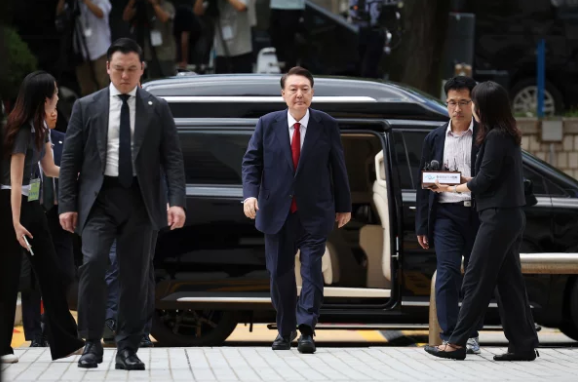
On February 19th, former South Korean President Yoon Suk Yeol was sentenced to life in prison for his attempts to impose martial law, suspend the National Assembly (the country’s national legislature), and direct the country’s military command to arrest political leaders and legislators opposed to Yoon in December of 2024. The decision came after the prosecution in his case failed to circumvent a national moratorium on the death penalty and the Seoul District Court accordingly ruled that his actions to overthrow the country’s government warranted a life sentence.
Yoon was elected to the presidency in 2022, winning by a plurality of votes. Throughout his term, his approval rating fell sharply amidst an inflation crisis, allegations of corruption and nepotism, and conflict within his own party, the conservative People Power, spurred by his favoring of the further-right “New Right” movement. By South Korea’s parliamentary elections in April of 2024, his public approval rating was dipping below 30%, and his party won only 36% of National Assembly seats, with his party’s primary opposition, the liberal Democratic Party, winning 58% of the Assembly’s seats.
Yoon subsequently boycotted the new legislature’s inaugural session. On December 3rd 2024, he delivered a televised address describing the Assembly dominated by his political opponents as a “legislative dictatorship” and accusing them of secretly collaborating with North Korea to destabilize the country. He used these accusations to justify a declaration of martial law, ordering the severing of utilities to media outlets critical of him (which the official who was directed to refused to do), directing a raid of the country’s National Election Commission headquarters, prohibiting gatherings of the National Assembly, and arranging a list of politicians—from both the opposition Democratic and his own People Power parties—to be arrested by the military and jailed.
The National Assembly convened an emergency session in defiance of Yoon’s order, and legislators barricaded themselves inside the National Assembly Building amidst a siege by police and military forces. After learning that enough legislators were present to vote to invalidate his decrees, Yoon called the Police Commissioner leading the Assembly siege in a panic, telling the military forces to break down the Assembly doors by any means available and capture the legislature’s leadership. By then, crowds of civilians had also gathered at the Assembly to demand Yoon’s impeachment and the lifting of martial law, further adding to the chaos.
The Assembly members present unanimously voted to end martial law, and the troops dissipated, some reportedly apologizing to civilian protestors for the disturbance. In the aftermath, Yoon told People Power leaders that he would willingly resign if they voted against his impeachment, the vote for which was held on December 7th. Without the party’s support, the motion to impeach Yoon failed, but he refused to resign, accusing his political enemies of “obstructing the constitution of Korea.” A second vote to impeach, which was held a week later, succeeded. Yoon was arrested on January 15, 2025, and, on April 4th, South Korea’s Constitutional Court unanimously decided to remove him from office.
The criminal court’s decision on February 19th is likely the final chapter in a saga that has been developing in the years since Yoon took office. Yoon will be serving a life sentence in prison for leading an insurrection, in addition to a separate 5-year sentence for obstructing his arrest. Several officials who helped execute his plan to take control of the government will also be serving many-year sentences (although none for life). Yoon, in the final hearing before his sentencing, insisted that his actions were meant to “safeguard freedom and sovereignty.”