
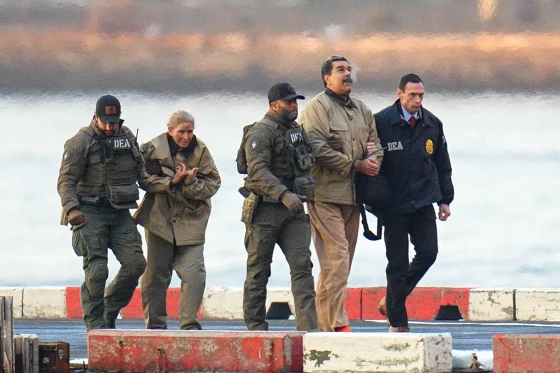
On the eve of January 3rd, 2026, Venezuelan Dictator Nicolás Maduro was captured from his presidential palace in a US military raid in the Venezuelan capital of Caracas. Details on the process of the raid itself are sparse. According to multiple sources, the operation involved the coordination of 150 military aircraft and apparent controlled power outages to cover a team on the ground, and a series of explosions were reported in the city during the operation.
Expectedly, Maduro’s abduction by a foreign power has caused a bit of a crisis with regards to who should lead Venezuela, and there are many actors attempting to fill the power vacuum. So, going forward, who could be in charge of Venezuela?
Nicolás Maduro?
Currently, Maduro and his wife, who was also captured during the raid, reside in Brooklyn’s Metropolitan Detention Center, a correctional facility currently home to Luigi Mangione and previously to Sean “Diddy” Combs, Sam Bankman-Fried, and Ghislaine Maxwell. The Trump administration’s stated intent in capturing Maduro is to bring him to court with charges of narcoterrorism; that is, using targeting drug trafficking to destabilize the United States. Maduro has plead not guilty, and maintained that he remains the President of Venezuela.
Neither the current Trump administration nor the previous Biden administration has recognized him as the legitimate Venezuelan president, due to his regime’s overriding of a 2024 election in which an opposition coalition covertly compiled election data proving that their candidate won, drawing international condemnation of Maduro for remaining in power. Maduro’s not exactly clean as a whistle, but the Department of Justice may have a tough time convicting him, especially after retracting its claim that “Cartel de los Soles,” an alleged drug cartel led by Maduro, is an actual organization, in favor of a likely easier-to-prove claim that he allows Venezuelan military officials to profit from the drug trade in a political patronage system. Between the trial and potential prison time, it’ll probably be a bit before he gets back to his presidential palace, so, while he still claims to be President of Venezuela, he’s unlikely to be making many executive decisions while he remains in custody.
María Corina Machado and Edmundo González?
In Venezuela’s 2024 election, after Maduro’s regime declared victory, it started cracking down even more than usual on political opposition, forcing the actual winner, Edmundo González, to flee the country, along with his VP candidate María Corina Machado. The two were awarded the EU’s Sakharov Prize for their vocal opposition to the Maduro regime’s anti-democratic crackdowns, and, after Maduro’s capture, the European Commission (the E.U.’s executive branch) voiced its support for a democratic transition involving González and Machado. If the party coalition which makes up Maduro’s main opposition is installed, Edmundo González could end up as president. Such an installation is unlikely to occur, though, given the recent souring of the relationship between the U.S. (and Trump in particular) and the exiled opposition.
María Corina Machado, despite her status as a vice presidential candidate to González in 2024 (due to being barred by the regime from running directly for president), is considered the face of the Venezuelan opposition. Additionally, she has long been in the United States’ good graces, being a consistent advocate for using U.S. military support to unseat Maduro. It was widely expected that she would be installed if Maduro were deposed, but, so far, that hasn’t happened. Instead, President Donald Trump has said that he doesn’t think Machado could lead Venezuela, telling reporters at a Mar-a-Lago press conference that “She doesn’t have the support within or the respect within the country”. Since Trump’s statements, Machado has redoubled her efforts to appeal to the president, offering on a Fox News interview to share her recently won Nobel Peace Prize with Trump.
Donald Trump?
So, if Trump’s calling the shots, does that mean he’s in charge? Well, he has declared himself Venezuela’s acting president. The United States has used its capture of Maduro to force sales of Venezuelan oil, threaten to block Venezuelan trade with Cuba, and demand the release of Venezuelan political prisoners. However, while Trump ostensibly dictates the flow of Venezuelan money and resources abroad, and is attempting to secure Venezuelan oil reserves for American use, Maduro’s ruling party is still in control of the country’s governance. In particular, pro-government militias have reasserted control in the streets of Caracas after Maduro’s capture, and Venezuelan Interior Minister Diosdado Cabello, who was rumored to have nearly as much political influence as Maduro, is still in control of the country’s policing system, albeit under the threat of a similar strike to Maduro’s if he makes any moves against U.S. interests. While Trump does have the leverage to make demands of Venezuela, its actual governance has changed little since Maduro’s ousting.
Delcy Rodríguez?
After Maduro’s capture, his Vice President, Delcy Rodríguez, has assumed power. Rodríguez is the de jure leader of Venezuela in Maduro’s absence, and appears to currently have Washington’s support. Diplomatically, the United States had been on better terms with Rodríguez than Maduro leading up to Maduro’s capture, and Rodríguez appears to have President Trump’s blessing to lead Venezuela, with him repeatedly praising her leadership during public appearances regarding the country’s situation. Her position is extremely precarious, perhaps more than anyone else here but Maduro’s, though. She is still threatened by a U.S. naval blockade and additional military presence in the Caribbean, and Trump recently announced that the U.S. military had planned, then discarded, a “second wave of attacks” on Venezuela. Additionally, María Corina Machado, the leader of the opposition, has planned to meet with Trump to bargain for her own installation, so U.S. support for Rodríguez could reverse on a dime. Internally, Maduro’s capture has intensified tensions between the different factions of Venezuela’s ruling party. Especially with the Venezuelan military doubling down on control while Rodríguez makes concessions to America, the possibility of an internal coup appears increasingly likely. For now, Rodríguez is, at least nominally, in control of the country
So, who is in charge of Venezuela? The simple answer: Delcy Rodríguez. After all, she’s the acting president of the country while Maduro remains in custody. However, her actual power is far lesser than the title would suggest: she’s competing for control of the country with a foreign leader attempting to extract natural resources and political power, militaristic internal factions which disdain the bargains she makes with the aforementioned foreign leader, and a vocal opposition party with support from an international sphere which (correctly) sees her status as illegitimate.