
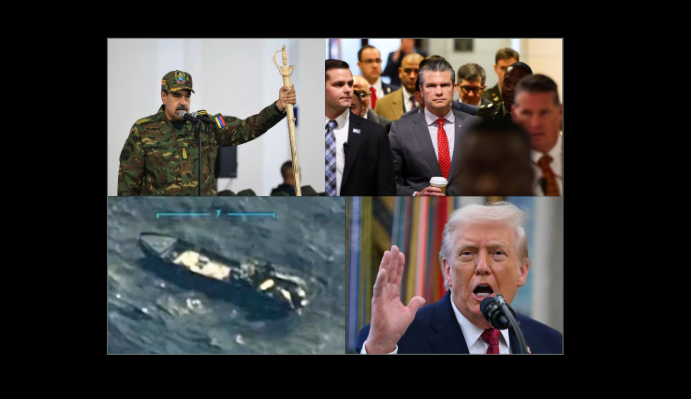
The United States appears to be threatening armed conflict against Venezuela and its dictator Nicolás Maduro, with President Donald Trump stating his intent to “stop [Venezuelan drug traffickers] by land” in late November. While (in my opinion) we won’t actually see U.S. troops deployed within the country (at least not anytime soon), the already-tense relations between the two countries are escalating. Trump and the Department of Defense have taken a variety of actions which are likely to accelerate this escalation and have placed the administration under increasing domestic and international scrutiny.
As of December 11th, the U.S. military has struck 22 boats in the Caribbean, and Pete Hegseth is under scrutiny for allegedly ordering that military strikes “kill everybody” aboard targeted alleged drug trafficking boats off the coast of Venezuela allegedly headed for the United States, allegedly leading an Admiral to order a strike on one boat intended to kill survivors of a previous strike in order to comply with Hegseth’s directive. This (if Hegseth did, and the admiral did) would likely violate Department of Defense-established rules of war precluding persons incapacitated by shipwreck from being the object of attack. You may notice that everything here is very alleged, and that’s because every part of this—the reason for the “second strike,” the destination of the boats, and whether or not the use of military force has been legally justified in any of the strikes—is disputed, and Hegseth is currently resisting congressional demands to release the full video of the strike.
On another nautical front, the United States also seized an oil tanker sanctioned for allegedly helping smuggle oil for foreign terrorist networks. The tanker was seized off the coast of Venezuela and was carrying Venezuelan oil, which both U.S. Attorney General Pam Bondi and Trump say the administration is intending to seize for U.S. use. This action has been sharply criticized not just by the Venezuelan government (who called it an “act of international piracy”), but also by officials of Cuba, to which the tanker was originally bound, although it reportedly offloaded oil onto another vessel bound for Cuba and turned east, presumably towards China, to which Venezuela exports the vast majority of its oil exports, shortly before being seized.
The actions taken against Venezuela appear to have two major goals: to lead to the overthrow of Nicolás Maduro, whose regime has overridden elections and jailed opposition to remain in power, and to support U.S. interests in Venezuelan oil. Those two motivations are not entirely separate. Recent Nobel Peace Prize winner Maria Corina Machado, the leader of a party coalition opposed to the Maduro regime, has long been an ally to the United States, and has promised favorable trade relations with the United States if the Venezuelan opposition gains control of government.
Meanwhile, Maduro has made an effort to paint himself as a defender against foreign aggression, referring to the United States as an “empire” and brandishing a sword used by Venezuelan revolutionary Simón Bolívar at a recent rally. As a U.S. invasion of Venezuela enters the realm of possibility, his regime has shored up support, notably from Russian president Vladimir Putin and other leaders around the globe. Leaders in neighboring countries Colombia and Brazil have suggested that Maduro could be offered asylum if he is deposed by a U.S. attack.
While the Trump administration is threatening armed conflict with its actions in the Caribbean (and the apparent threat of a ground invasion), there is one gigantic stumbling block preventing it from making an outright declaration of war: public opinion. Invading Venezuela is a broadly unpopular action in the States, and likely to alienate the U.S.’s international allies as well as push uninvolved countries towards siding with Venezuela. For the administration, continuing to strike boats and seize tankers is a safer bet because it keeps pressure on Maduro without further turning public opinion against it.
So, the United States is walking a pretty fine line by posturing as if it’s preparing for war while having numerous incentives not to actually go to war. Is the situation precarious? Yes, but we won’t be having a draft anytime soon.