


Living in an Anxious World According to Academic Magnet Students
Introduction
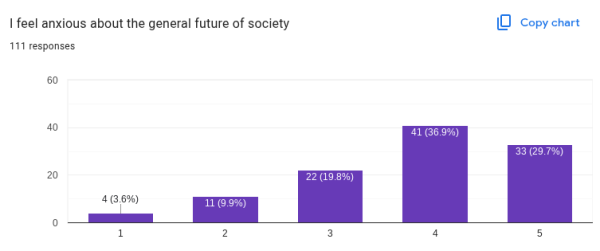
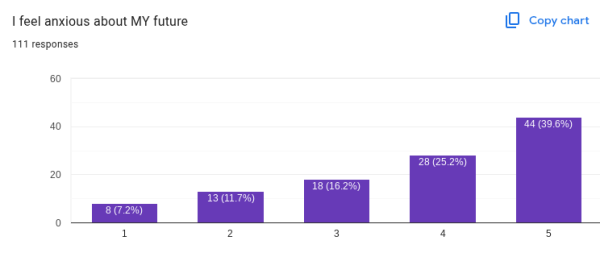
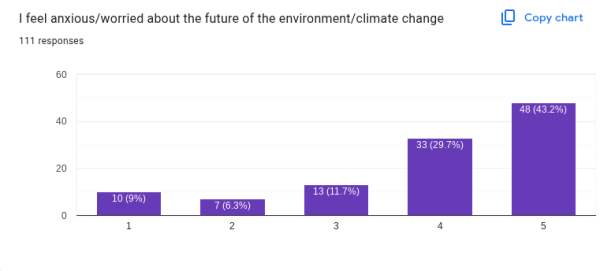
According to an article by Harvard Public Health staff (2025), “people under 30 in the U.S. ranked 62nd for happiness among 143 countries surveyed.” Another source by Christina Caron (2025) from The New York Times describes a study that “found that, on average, young adults between the ages of 18 and 29 were struggling — not only with happiness, but also with their physical and mental health, their perceptions of their own character, finding meaning in life, the quality of their relationships and their financial security.” To research this topic at our own school, I surveyed 111 students across all grades and the results hopefully will help shed light on how students at this school feel about the future and their overall optimism. The vertical bar graph is read as 1 being “Not at all true” and 5 being “Very true.” After I obtained the results I categorized them and gave tips to hopefully combat the negative feelings that the younger generation faces.
Perception of Society vs. Self
The students that were surveyed felt about the same regarding their anxiety about their own future and the future of society as a whole, with the majority rating it high at a 4 or 5. Specifically, around 67% of students felt more anxious than not about the future of society (rating it a 4 or 5) while 65% of students felt more anxious than not about their own future. It is normal for a teenager to be anxious about the future, but research has shown that Gen Z is experiencing a higher level of this anxiety. According to an article by Emily Sohn (2024) from the American Psychology Association, “[t]he shift, according to Professor David Blanchflower of Dartmouth College in the US, is not due to middle-aged people suddenly becoming more cheerful. Instead, [Generation Z (1997-2012)] is far more prone to despair and anxiety than previous generations in their early twenties.”
Feelings about Social, Economic, and Other Issues
Economic Issues
The feelings of students about economic issues including well-paying jobs, college debt, and buying a house were all slightly left-skewed. Around 46% of students rated a 4 or 5 about being scared they will not get a well-paying job. The rising prices of housing, especially in the area where we live as more people move to South Carolina, most likely had an influence on the feelings of students surveyed. Around 53% of respondents on the survey rated a 4 or 5 on being scared they will not be able to buy a house, while around 42% rated a 4 or 5 for being worried about college debt. However, the distribution for being worried about college debt was bimodal, with students equally rating it at a “2” and a “5”, which is interesting.
“A lot of young people are not getting married and settling down and having kids because they can’t afford it,” Jeffrey Hall, a communications professor at the University of Kansas, explains as noted by Aditi Shrikant (2024) from the Consumer and Business Channel.


AI and the Environment
The percentage of students that put a 4 and 5 as their answers for anxiety about the future of the environment/climate change amounted to around 73%, while the percentage of students that put a 4 or 5 for being scared/worried about the future of AI amounted to around 63%. According to an article by Susan Clayton et al. (2023) from the American Psychological Association, “[Adolescents and young people] are susceptible to the mental health effects of extreme weather, high temperatures, and the chronic and indirect impacts of climate change.” This research supports the data found by my survey as almost ¾ of the students surveyed put a higher rating for their anxiety about the future of the environment, most likely because everyone can be directly affected by it.

Social Media and Loneliness
According to an article by Shrikant (2024) from the Consumer News and Business Channel, “Some 44% of U.S. teens ages 13 to 17 say it’s harder to be a teenager today than it was 20 years ago, according to Pew Research. The No. 1 reason they provided was “more pressures and expectations” (31%)…” According to the survey, around 50% of students at Magnet put a 4 or 5 for social media, especially posts containing news, invoking negative emotions or confusion. I chose to ask this question because I had seen news about Generation Z looking towards social media instead of traditional news outlets but I have not seen how Generation Z interprets and feels about the news on social media. Social media and those who post social media content are often targeted at a specific audience and framed, whether consciously or subconsciously, in a way that invokes emotions (Edda Humprecht et al., 2024). It is also so much easier to access and be instantly informed by new information than in previous generations, and people younger and younger are exposed to so many things on social media. I have also seen news about the “loneliness epidemic” that is occurring, so I wanted to ask a question about that. An article by Elizabeth M. Ross (2024) found that “[a]mong 18–29-year-olds — the rate [of loneliness] was 24%,” which is similar to the results I found on my survey that had around 23% of respondents rated their loneliness at a 4 or 5. 
Optimism and Perfectionism
The majority or 52% of students rated their optimism for the future of our country on the lower end at a 1 or 2. However, data from the students’ optimism about the future of the world was higher, with around 39% of students rating it at a 1 or 2. These ratings reflect the turbulent time that we live in.


When asked whether the pressure to succeed makes students anxious, a total of around 62% of students put a 4 or 5.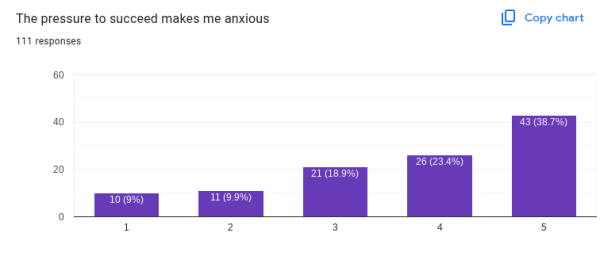
Solutions
- Be environmentally conscious – turn off lights and taps when not in use, use less AI (it wastes water), buy clothes from sustainable sources such as Depop or a second-hand/thrift store.
- Care for others’ needs
- Be empathetic to others and listen to their opinions to gather a better understanding, even when you do not agree.
- Surround yourself with positive and supportive people
- Think positively and treat yourself with kindness
References
(I could not figure out how to do a hanging indent on the newspaper website)
Caron, C. (2025, April 30). A global flourishing study finds that young adults, well, aren’t. The New York Times. https://www.nytimes.com/2025/04/30/well/mind/happiness-flourishing-young-adult-study.html
Clayton, S., Manning, C., Hill, A. N., Speiser, M., Camalotte Foundation, Joseph and Susan Gatto, Lise van Susteren, Bonwood Social Investments, American Psychological Association, ecoAmerica, Jones, S., Treadwell, E., Yalamanchili, D., Bekkar, B., Brown, A.-N., Jasilyn Charger, Adah Crandall, Hannah Estrada, Jennifer Giordano, . . . Stolle, D. P. (2023). Mental Health and Our Changing Climate: Children and Youth Report 2023. In ecoAmerica & American Psychological Association, American Psychological Association and ecoAmerica. https://www.apa.org/news/press/releases/2023/10/mental-health-youth-report-2023.pdf
Harvard Public Health staff. (2025, November 21). Why are young people in the U.S. so unhappy? | Harvard T.H. Chan School of Public Health. Harvard T.H. Chan School of Public Health. https://hsph.harvard.edu/news/why-are-young-people-in-the-u-s-so-unhappy/
Humprecht, E., Amsler, M., Esser, F., & Van Aelst, P. (2024). Emotionalized Social Media Environments: How Alternative News Media and Populist Actors Drive Angry Reactions. Political Communication, 41(4), 559–587. https://doi.org/10.1080/10584609.2024.2350416
Ross, E. M. (2024, October 25). What is Causing Our Epidemic of Loneliness and How Can We Fix It? Harvard Graduate School of Education. https://www.gse.harvard.edu/ideas/usable-knowledge/24/10/what-causing-our-epidemic-loneliness-and-how-can-we-fix-it
Shrikant, A. (2024, August 29). Americans under 30 are miserable compared to Boomers: ‘The future is looking pretty bleak’. CNBC. https://www.cnbc.com/2024/08/28/young-adults-are-unhappy-than-ever-but-dont-just-blame-social-media.html
Sohn, E. (2024, October 1). Perfectionism and the high-stakes culture of success: the hidden toll on kids and parents. American Psychology Association. Retrieved February 5, 2026, from https://www.apa.org/monitor/2024/10/antidote-achievement-culture
Whittaker, R. (2025, August 28). The unhappiest age might surprise you – and it’s not midlife. The Independent. https://www.independent.co.uk/news/health/gen-z-unhappiest-generation-midlife-anxiety-b2815600.html




zavier nutting • Feb 12, 2026 at 2:57 pm
HIIIIII!!!!!!!! :DDDDDD XD