


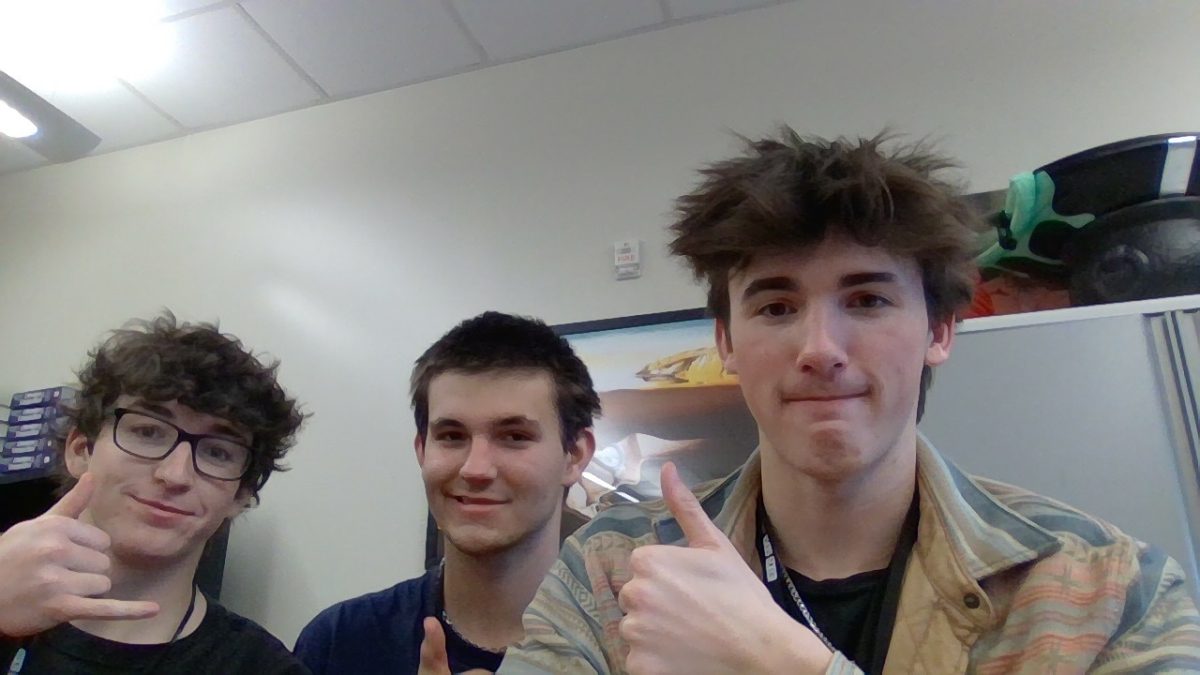
I need to set the record straight right away: I was never supposed to be on the mic. I was the editor. The visionary. The silent architect behind the chaos. Quin O’Keefe and Jack Childers were the voices of the operation, the faces of the brand, the men who thought shouting louder automatically made the broadcast better. I was the one behind the screen at 1 a.m., stitching together clips, fixing audio spikes, and wondering how my life ended up revolving around a high school sports casting show that had absolutely no business being taken seriously—especially because we took it extremely seriously.
The show started, like all bad ideas do, as a joke. Someone said, “We should commentate the games,” and instead of laughing and moving on like normal people, Quin leaned forward with that dangerous look in his eye and said, “No. We should.” Jack immediately backed him up, despite not knowing how microphones worked yet. Within a week, we had a name, a logo that I made in about twelve minutes, and a promise to the athletic department that we were “enhancing school spirit.” What we were actually doing was creating the loudest, most unhinged sports broadcast the school had ever heard.
Quin was the play-by-play guy, which made sense because he talked faster than anyone I’ve ever met and physically could not stop himself from narrating events. He treated every game like it was the final seconds of a state championship, even if it was a Tuesday afternoon JV matchup where half the players were visibly confused about where they were supposed to stand. Quin had catchphrases he invented mid-sentence and then reused like they were iconic. He’d scream “BANG” after a routine layup, pause dramatically after every whistle, and say things like “this is where legends are made” while someone missed a free throw by six feet.
Jack was the analyst, although that title was generous. His job was to explain what was happening, except half the time he explained things that were not happening, had never happened, and could not possibly happen under the rules of the sport. He would confidently break down plays that didn’t exist, critique strategies teams were not using, and occasionally just start talking about unrelated historical facts. One time during a volleyball match, he spent two full points explaining why momentum was “a mindset, not a statistic,” while Quin yelled over him about a serve that hadn’t gone in yet.
Meanwhile, I sat in the editing chair, watching all of this unfold through a cracked laptop screen, desperately taking notes for what I’d need to fix later. I learned very quickly that editing our show was less about polishing and more about damage control. Audio levels were a suggestion. Quin would peak the mic every time something mildly exciting happened, and Jack would drift so far away from the microphone that his voice sounded like it was being recorded from another zip code. My editing sessions were a constant cycle of boosting, cutting, muting, and occasionally sighing deeply while staring at the timeline.
Our first broadcast was a disaster in every measurable way. The camera angle was crooked, the scoreboard graphic was wrong for almost the entire first half, and Quin accidentally introduced Jack by the wrong name. Jack responded by rolling with it and claiming it was his “broadcast persona.” Somehow, people watched anyway. Not a lot of people, but enough to encourage us, which was frankly the worst possible outcome. Once we knew we had an audience, however small, it was over. The show became our identity.
As editor, I tried to impose structure. I made intro sequences, lower thirds, and transition screens. Quin ignored them and talked over the intro every single time. Jack insisted we needed “rawness” and argued that cutting his rants shortened his “vision.” My vision, apparently, was to stay up until midnight syncing audio because Quin clapped directly into the mic after a buzzer beater. Still, I kept going, because every time I exported a finished episode, there was a weird sense of pride attached to it.
The booth itself became legendary. It was cramped, overheated, and smelled faintly like energy drinks and regret. Quin took up as much physical and vocal space as possible, Jack spun around in his chair like a villain explaining his master plan, and I sat wedged in the corner with headphones on, silently judging both of them. They would argue mid-broadcast about rules, calls, and occasionally who was better at their job, all while I marked timestamps for edits I already knew wouldn’t save the segment.
Somehow, the ridiculousness became the appeal. People started quoting Quin’s overreactions in the hallways. Jack’s terrible analogies became inside jokes. Teachers would ask me, completely seriously, when the next episode was dropping. I’d nod politely, knowing full well I still had three hours of footage to clean up and a hard drive that was begging for mercy. I was no longer just a student, I was post-production.
By the end of the season, we were running on pure momentum and delusion. Quin believed we were “changing the game.” Jack talked about expanding the brand. I talked about storage space and render times. Yet somehow, when I watched the final cut of our last broadcast, it worked. Not because it was professional, or polished, or technically impressive, but because it was us. Loud, chaotic, overconfident, and held together by my editing timeline.
I was the editor. Quin O’Keefe and Jack Childers were the sports casters. And against all logic, we ran a high school sports casting show that people actually watched. That fact still doesn’t make sense to me, but I have the exported files to prove it happened
